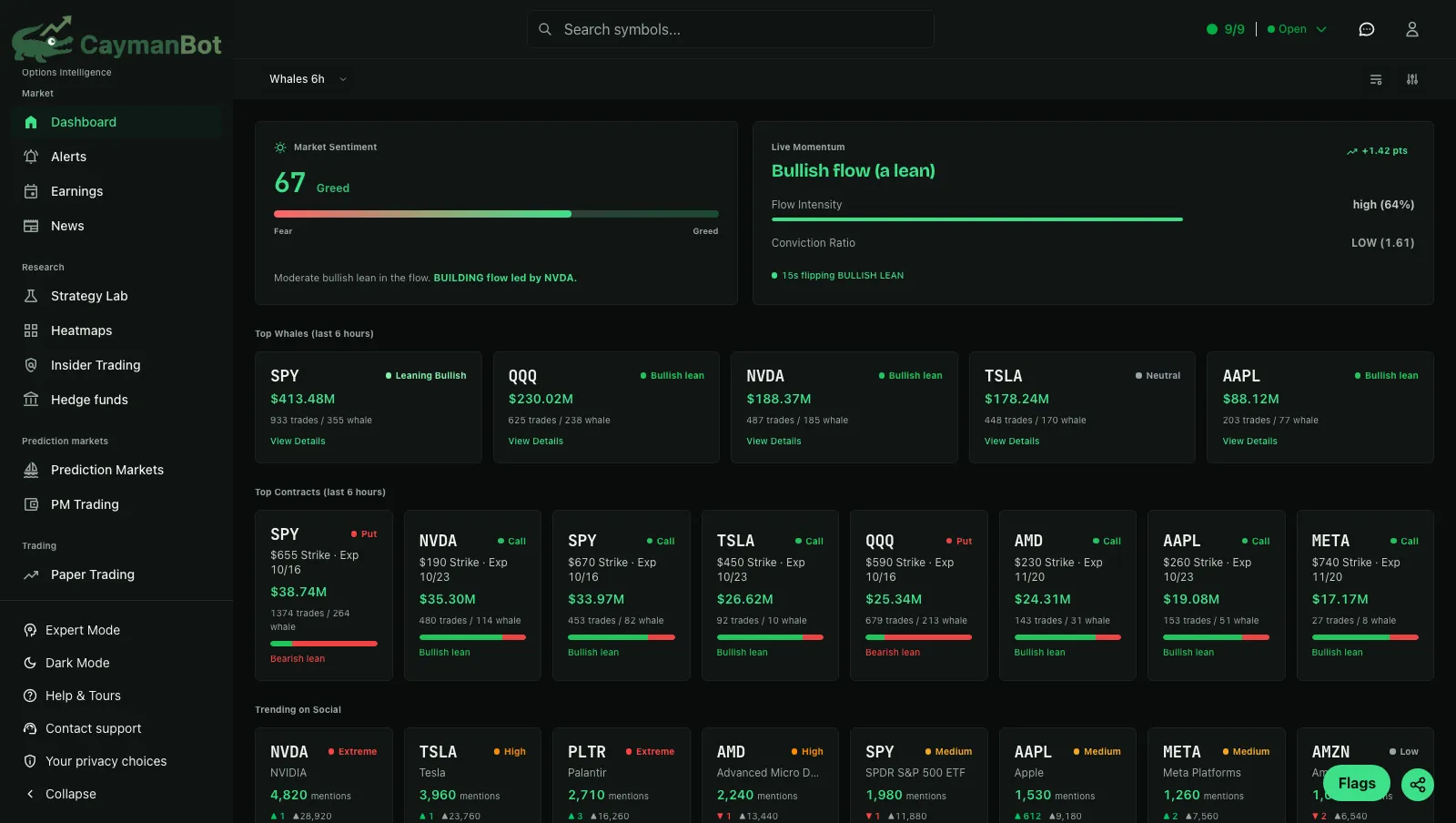
Options market data and flow classifications
CaymanBot, LLC receives consolidated options market data as a licensed OPRA vendor. Real-time options data is delivered to Premium subscribers who have completed the OPRA non-professional attestation; Free-plan data is delayed and conspicuously labeled as delayed. CaymanBot organizes options transactions and related quote context from licensed and permitted market-data sources. Displayed fields can include symbol, contract, price, size, premium, exchange time, bid, ask, volume, open interest and calculated Greeks when available.
Labels such as bullish, bearish, ask-side, bid-side, sweep, unusual or whale are classifications derived from observable trade and quote characteristics. They are not account-level knowledge. A displayed leg may open or close risk, belong to a spread or hedge another position that the tape does not reveal.
Modeled exposure and analytics
GEX, VEX, Charm, flip levels and related metrics are estimates produced from option data and model assumptions. Inputs and methodology can differ across platforms, and results can change with spot price, volatility, time, open interest, new volume and the expiration set included.
CaymanBot presents snapshot time and surrounding profile where possible so users can judge freshness and avoid treating a single modeled level as certain support, resistance or direction.
- Market-data entitlements can affect whether a user sees real-time or delayed values.
- Greeks and exposures are model outputs rather than guaranteed future changes.
- Illiquid markets and wide quotes can reduce the reliability of execution inferences.
- Corporate actions and symbol changes can require historical normalization.
Public filings and prediction markets
Congressional disclosures, SEC insider reports and 13F holdings originate from public filing systems. CaymanBot normalizes fields for comparison, but filings can be delayed, amended, incomplete or reported in ranges. The original filing is authoritative when exact legal details matter.
Prediction-market views reflect provider data and on-chain prediction-market data where supported. Prices may be interpreted as probabilities but remain affected by liquidity, fees, market rules and resolution criteria. Wallet labels and performance summaries cannot reveal off-platform hedges or identity unless independently established.
Corrections and responsible use
Upstream corrections, late events and improved normalization can change historical records. Users who find a suspected data issue can contact support@caymanbot.com with the page, symbol, timestamp and source detail so the record can be investigated.
CaymanBot provides informational research tools, not individualized investment advice. Users remain responsible for verifying source material, understanding product specifications and applying their own risk controls.