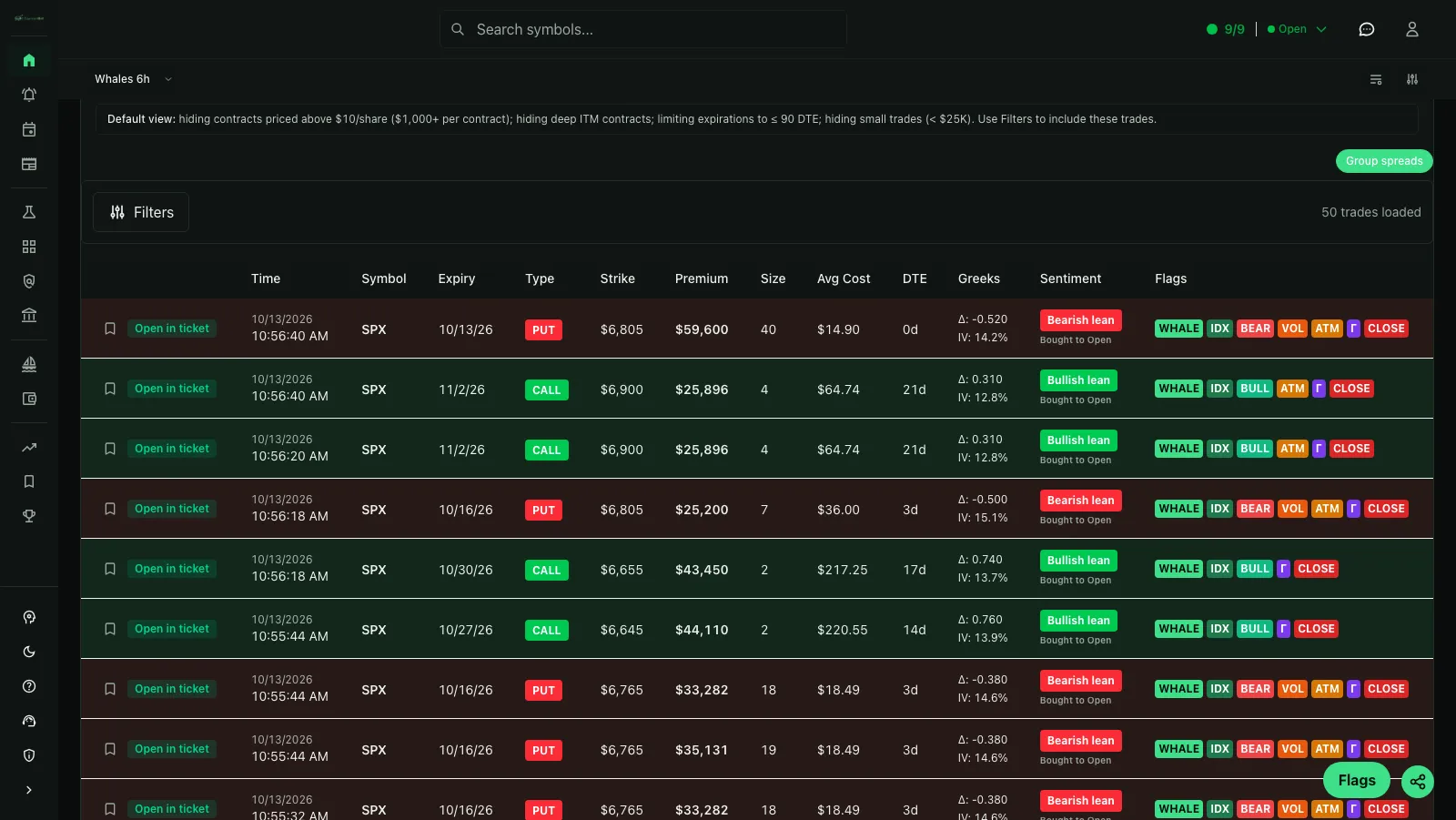
1. Identify what traded
Every options-flow interpretation should begin with the contract itself: underlying symbol, call or put, strike, expiration, execution price and contract size. Premium is the execution price multiplied by the number of contracts and the standard contract multiplier, normally 100 for a conventional equity option. Adjusted contracts can have different deliverables, so the compact symbol and contract specifications still matter.
Expiration and moneyness change the economic meaning of the same premium. A near-the-money contract expiring today can react very differently from a far-dated contract at the same strike distance. Compare days to expiration, underlying price and available Greeks before treating two prints as equivalent.
2. Compare execution with the bid and ask
A trade printed near the ask is often interpreted as buyer-initiated, while a trade near the bid is often interpreted as seller-initiated. A call apparently bought near the ask is commonly labeled bullish; a put apparently bought near the ask is commonly labeled bearish. Trades between the quoted prices are less conclusive.
This is an inference, not account-level truth. Quotes can move around the execution, a print can be reported after the relevant quote changed and one visible leg can belong to a complex order. A bought call may hedge a short stock position, while a sold put may be one leg of a spread. Use bid/ask classification as evidence, not a verdict.
4. Recognize sweeps, multi-leg orders and repeated flow
A sweep groups executions that pursued liquidity across venues quickly. It can indicate urgency, but urgency does not reveal whether the order opens, closes or hedges risk. A multi-leg order combines options, and sometimes stock, into one strategy; judging one leg alone can invert the economics of the complete trade.
Repeated activity can be more informative than one dramatic print when related contracts appear across the same symbol, expiration or price level. Still check whether the repetitions share an order or strategy identifier. Several displayed legs from one complex order are not several independent traders reaching the same conclusion.
5. Use a repeatable options-flow checklist
A useful options flow scanner preserves enough detail to challenge the initial signal. Filter the tape to reduce noise, but open the underlying contract and test the hypothesis against other independent evidence before taking risk.
CaymanBot’s options flow scanner filters the tape by ticker, call or put, premium, size, strike, DTE and execution side, and opens each print for contract-level research.
Before you size a position, the option profit calculator shows what a call or put would pay at expiration across a range of stock prices.
- Confirm the contract, timestamp, price, size, premium and bid/ask context.
- Check DTE, moneyness, implied volatility, Greeks, liquidity and the quoted spread.
- Look for related strikes, expirations, strategy legs and repeat activity.
- Review the underlying chart, market regime, earnings, news and other known catalysts.
- Define an invalidation point, position size and exit plan independently of the flow label.
- Use alerts, historical testing and paper trading to evaluate a rule instead of chasing isolated prints.
What options flow cannot reveal
Public options order flow does not identify the beneficial owner, reveal the rest of an account or guarantee whether a position opened or closed. Terms such as smart money, institutional flow, whale, bullish and bearish are useful shorthand only when their classification method and uncertainty remain visible.
No options flow software can turn one tape print into certainty. Use the data for discovery and confirmation, account for options-specific risks and consult the current OCC disclosure document before trading standardized options.
Primary sources
Definitions, source details and material claims were checked against these primary references.