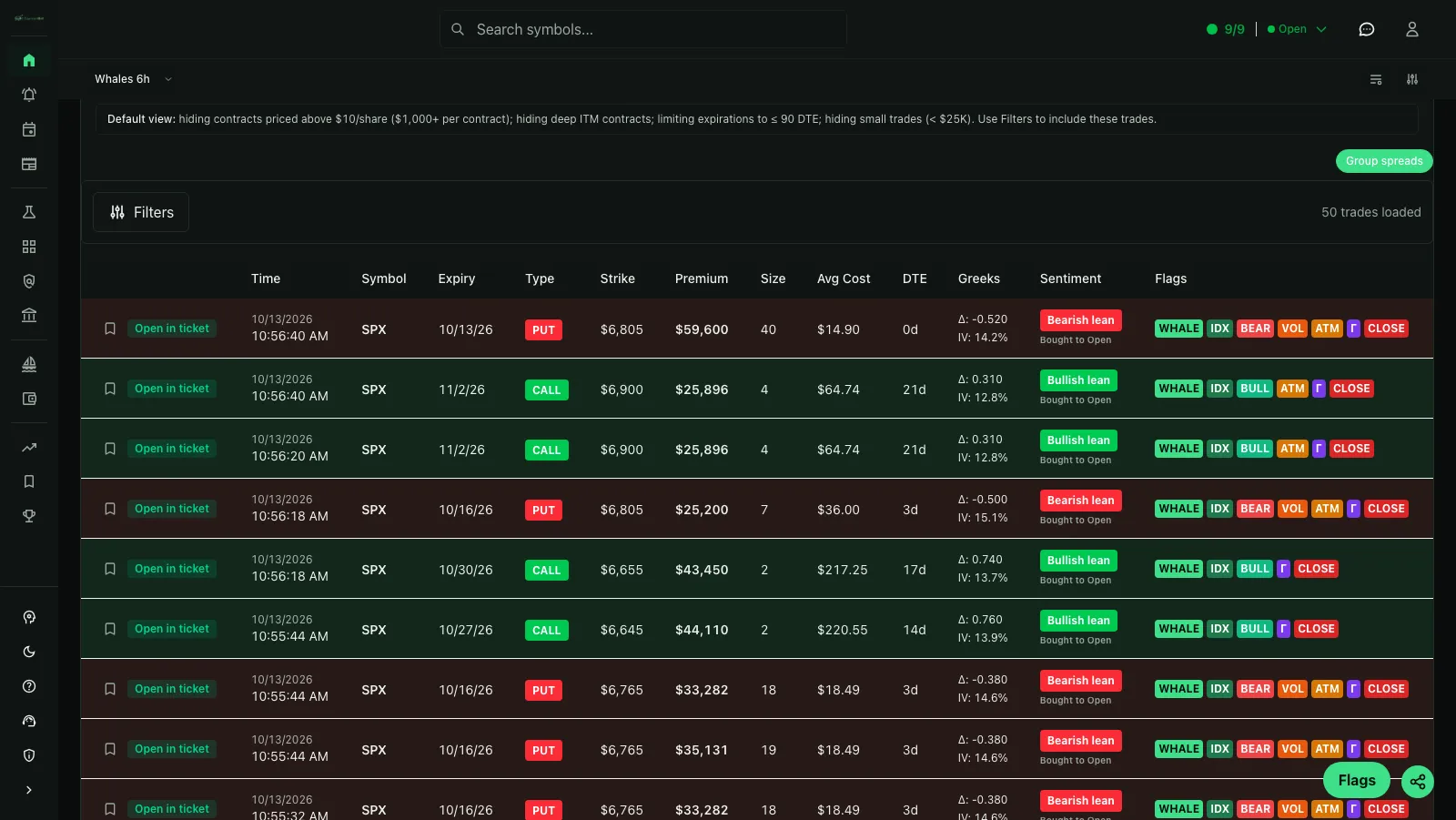
How an options sweep works
U.S. listed options trade across multiple exchanges. The best available price and size may be split between venues, so an order can route to several exchanges in rapid succession to fill more contracts. Flow systems group those related executions and label the result a sweep.
Speed can imply that the initiator valued completion over waiting passively for a better price. That urgency is the useful observation. It still leaves major questions unanswered: the trade may open or close exposure, hedge stock, form one leg of a spread or offset risk elsewhere in a portfolio.
How to read call and put sweeps
A call sweep purchased near the ask is commonly classified as bullish, while a put sweep purchased near the ask is commonly classified as bearish. Those labels describe a reasonable inference from the visible leg. They do not identify the account’s net exposure.
A sold call can be bearish or income-oriented, a purchased call can hedge a short position and a purchased put can protect a long portfolio. Complex orders can make a single leg appear directionally opposite to the combined strategy.
- Check whether execution clustered near the bid, midpoint or ask.
- Compare total premium and size with normal liquidity in that chain.
- Look for matching strikes, expirations or timestamps that suggest other legs.
- Check whether similar activity repeats across the session.
- Review earnings, news and implied volatility before forming a thesis.
Sweep versus block trade
A sweep seeks fills across venues, while a block is generally a large transaction printed together after counterparties arrange the size. Neither label is inherently more bullish or informative. A block may represent negotiated institutional risk transfer; a sweep may simply be the practical way to fill an order in a fragmented market.
Treat both as discovery events. The stronger case comes from multiple independent facts—price behavior, repeat activity, a plausible catalyst, sufficient liquidity and risk that can be defined before entry.