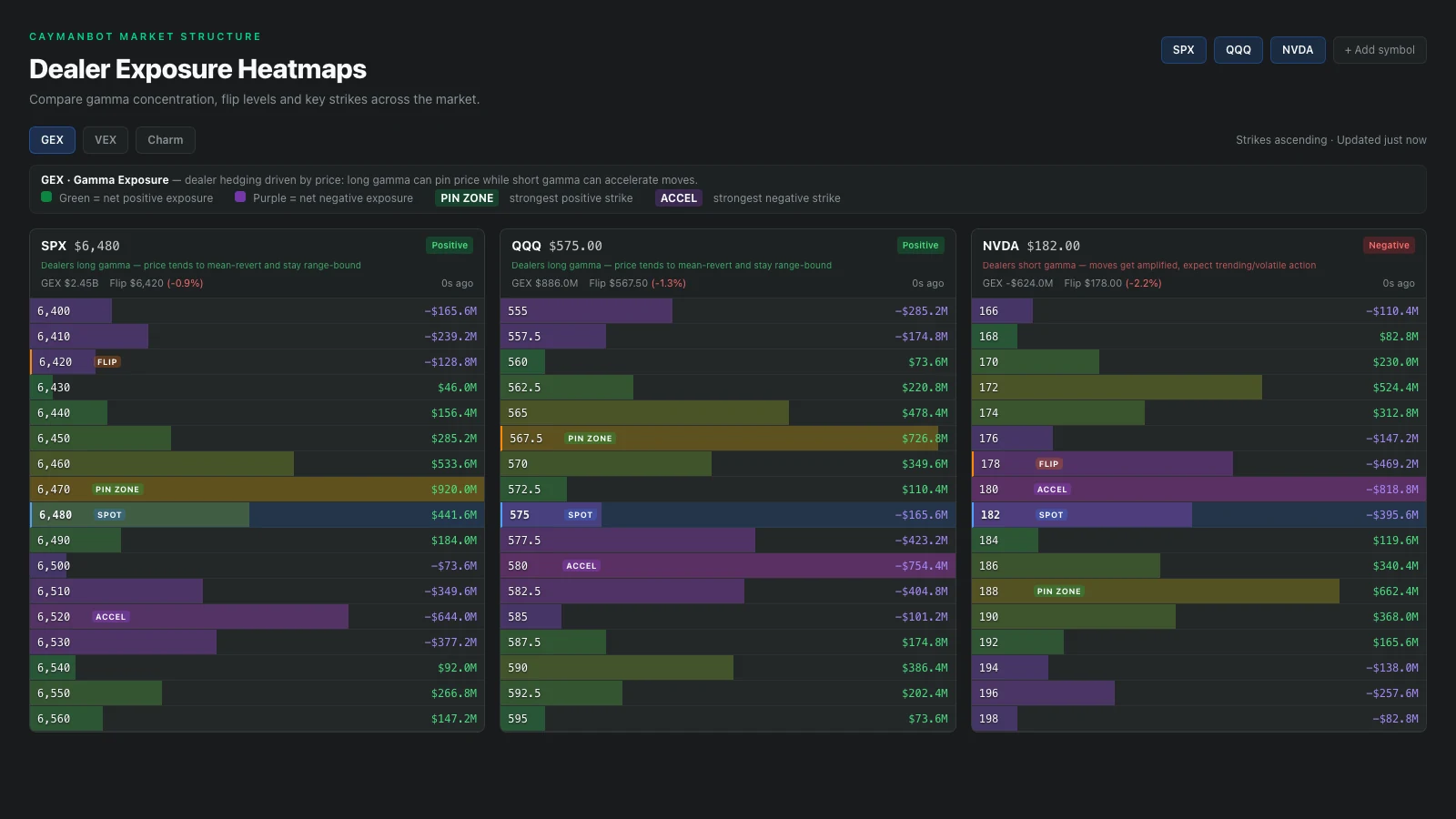
What AAPL gamma exposure shows
Gamma exposure (GEX) estimates how much options dealers might need to buy or sell AAPL as its price moves, from the open interest at each strike. Positive net GEX at a strike means dealers are modeled long gamma there, which tends to dampen moves; negative net GEX means they are modeled short gamma, which can amplify them. It is a positioning model, not a record of anyone's trades and not a forecast.
The table above shows the strikes within 10% of the snapshot's AAPL price. Total GEX adds every strike together and is stated per 1% move in the stock, the same scale the CaymanBot app uses.
How to read the AAPL gamma flip, call wall and put wall
The gamma flip is the estimated AAPL price where net gamma changes sign. Above it the model has dealers long gamma, below it short gamma, so the regime reads positive or negative depending on where the price sat at the snapshot. The call wall is the strike with the largest call GEX and the put wall the strike with the largest put GEX, often levels traders watch as resistance and support. None of these levels is guaranteed to hold.
- Positive regime: AAPL was above the modeled flip, where hedging tends to dampen moves.
- Negative regime: AAPL was below the flip, where hedging can amplify moves.
- Call wall and put wall: the largest call and put GEX across all strikes, even outside the shown window.
- No flip detected: net gamma did not change sign across the strikes in the snapshot.
AAPL GEX on this page and in the app
This page shows one completed session, delayed at least 48 hours, and is free with no account. The AAPL options page shows the same session's call and put volume, premium, put/call ratio and active strikes next to its GEX. The GEX heatmap in the CaymanBot app updates during the session and shows every expiration. Sign up free to open it. New accounts start with a 14-day Premium trial.
Gamma exposure for other tickers: SPY, QQQ, NVDA, TSLA, AMZN, META, MSFT.
Primary sources
Definitions, source details and material claims were checked against these primary references.