Options flow and execution terms
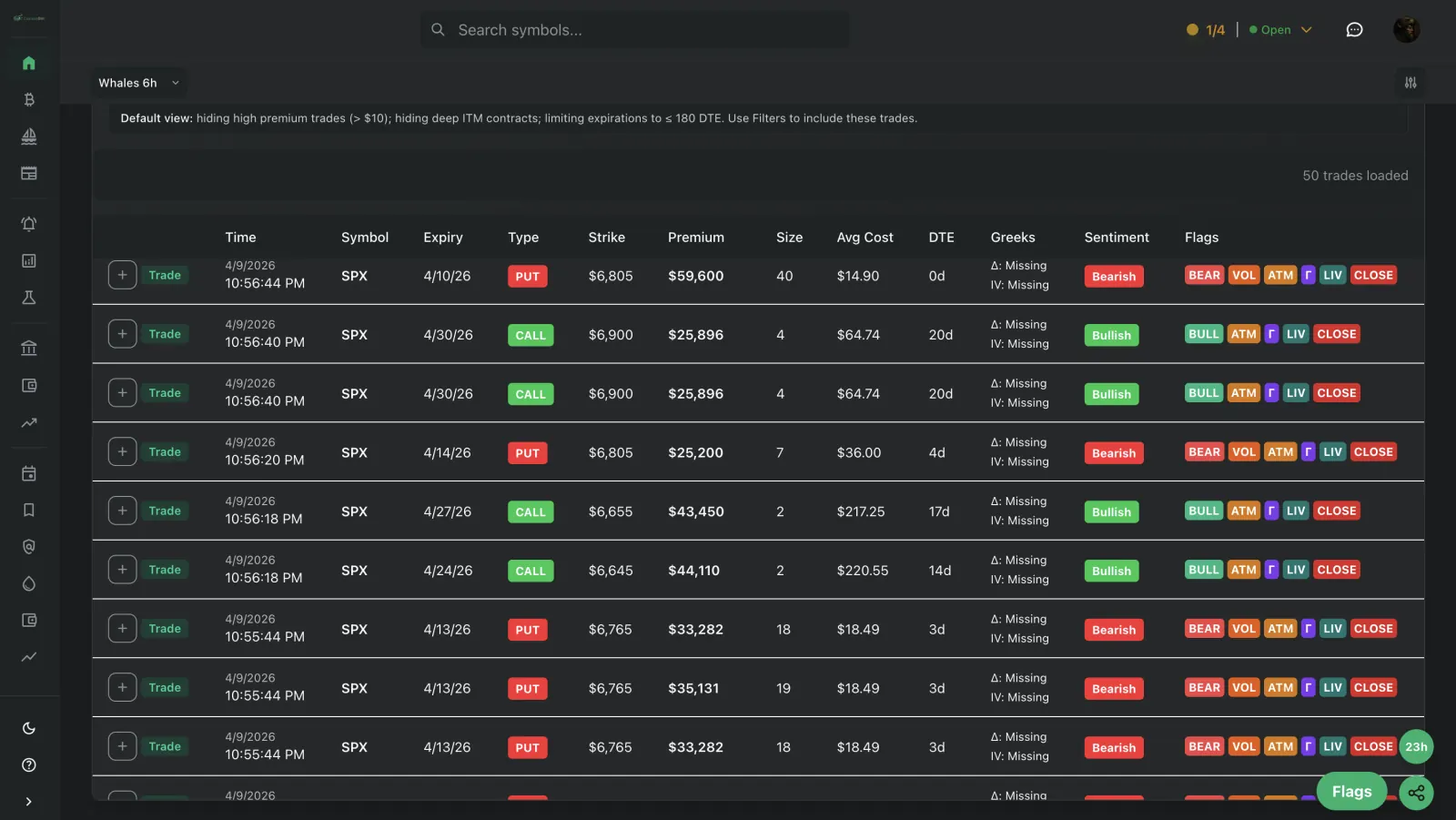
Options flow: A stream of options transactions organized to expose contract details, size and execution context. Flow describes what traded, not the full intent of the participant.
Sweep: An order routed across multiple exchanges to fill quickly. Sweeps can suggest urgency, but they can also be hedges or part of a complex position.
Block: A large negotiated transaction generally executed as one print. Size thresholds vary by product and scanner.
Premium: The option price multiplied by the contract multiplier and number of contracts. For standard U.S. equity options the multiplier is usually 100.
Bid-side / ask-side: A description of where the print occurred relative to the quoted market. Trades near the ask are often labeled buyer-initiated and trades near the bid seller-initiated, but quote changes and complex orders can make that inference wrong.
Mid-market: The price halfway between the displayed bid and ask. A midpoint execution provides less directional evidence than an aggressive trade at one side of the spread.
Multi-leg order: Two or more related option or stock legs executed as one strategy. Reading one leg without the others can reverse the apparent directional meaning.
Contract and positioning terms
Call: A contract giving the holder the right, but not the obligation, to buy the underlying at the strike before or at expiration, depending on exercise style.
Put: A contract giving the holder the right, but not the obligation, to sell the underlying at the strike.
Strike price: The price at which the contract can be exercised.
Expiration: The date after which the option ceases to exist. Short-dated options react differently to price, volatility and time than longer-dated contracts.
Volume: The number of contracts traded during the current session.
Open interest: The number of contracts that remained open after the prior clearing cycle. Same-day volume is not immediately included, so volume above open interest does not prove every trade is opening.
In the money (ITM): A call with strike below spot or a put with strike above spot.
At the money (ATM): A contract whose strike is near the current underlying price.
Out of the money (OTM): A call with strike above spot or a put with strike below spot.
0DTE: An option expiring on the current trading day. Its sensitivity and risk can change extremely quickly.
Volatility and Greek terms
Implied volatility (IV): The volatility input consistent with an option’s market price under a pricing model. IV reflects supply, demand and expected uncertainty; it is not a direct forecast of direction.
Delta: An estimate of how much an option’s price changes for a one-unit change in the underlying, all else equal. Delta also changes as conditions change.
Gamma: The rate at which delta changes as the underlying price changes.
Theta: An estimate of option value lost with the passage of time, holding other inputs constant.
Vega: Sensitivity to a change in implied volatility.
Gamma exposure (GEX): A modeled estimate of aggregate gamma positioning and the hedging sensitivity it may create.
Vanna exposure (VEX): A model of how delta may change as implied volatility changes.
Charm: A measure of how delta changes as time passes, holding other inputs constant.
Signal and risk terms
Unusual options activity: Trading that stands out relative to normal size, premium, volume, strike, expiration or execution behavior.
Whale: Informal shorthand for a participant placing a relatively large trade. The label says nothing certain about skill or information.
Bullish flow / bearish flow: A scanner’s directional classification based on observable execution and contract details. It is an inference, not knowledge of the complete position.
Opening / closing: Whether a trade creates a new position or offsets an existing one. This is often uncertain in real time without account-level data.
Liquidity: The ability to trade size with limited price impact. Quoted spread, displayed size, trade frequency and open interest can all provide partial clues.
Slippage: The difference between an expected price and the actual execution price.
Assignment: The obligation imposed on an option seller when the holder exercises.
Defined risk: A position whose maximum loss can be bounded in advance under its structure, though execution and assignment still require attention.